
How mortgages work in Switzerland
In Switzerland, the vast majority of homeowners never repay their property loan in full. This is a fundamental difference from France and other European countries: here, a mortgage is a long-term financial instrument, not a loan to be cleared in 20 or 25 years.
The financing is split into two tiers:
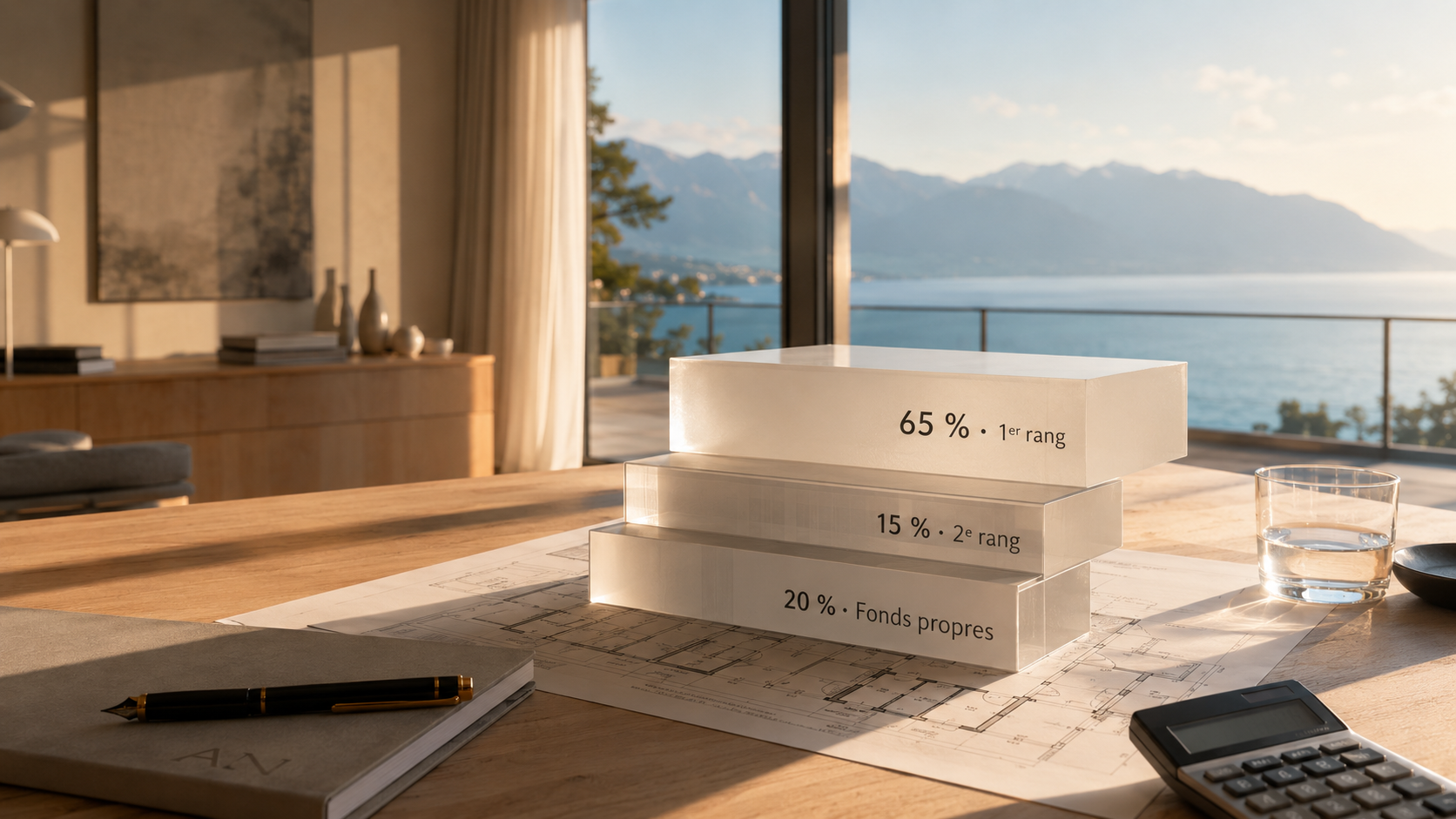
- The first tier (up to 65% of the property’s value): this portion does not need to be amortised. You pay interest only, with no obligation to repay the capital. In practice, many Swiss homeowners keep this first tier for their entire lives.
- The second tier (from 65% to 80% of the value): this tranche must be amortised within a maximum of 15 years, or before the age of 65. It is the only part of the loan you are required to repay gradually.
Primary residence only
The proportions described in this article (80% mortgage, 20% equity) apply to the purchase of a primary residence. For a second home, banks generally require at least 25% to 30% in equity and will not accept the occupational pension (2nd pillar). For properties regarded as luxury assets (priced above CHF 3 to 4 million depending on the institution), equity requirements can reach 35% to 40% and financing terms are negotiated on a case-by-case basis.
Financing breakdown: Property worth CHF 1’000’000
2nd tier: mandatory amortisation over 15 years
Equity: of which at least 10% in hard own funds
This system explains why the Swiss market is structurally different: homeowners remain in debt to their bank, but in return they benefit from a tax deduction on mortgage interest. It is a deliberate balance struck between taxation and financing.
Good to know
In Switzerland, mortgage interest is deductible from taxable income. One caveat, however: the reform approved by popular vote on 28 September 2025 provides for the abolition of the imputed rental value and, in return, the removal of mortgage interest deductibility for a primary residence; it is expected to come into force in 2028 at the earliest. This is one of the reasons why repaying a mortgage in full is not always advantageous, even when you have the means to do so.
Equity: how much do you need to put in?
The rule is clear: you must contribute at least 20% of the property’s value in equity. But be aware that not all equity is equal.
- “Hard” own funds (minimum 10%): personal savings, the 3rd pillar (pillar 3a), a gift, an advance on inheritance, or the pledging of a life insurance policy. These funds are required by the bank and cannot come from the occupational pension (2nd pillar).
- Occupational pension (2nd pillar, LPP): you can withdraw or pledge your pension assets to make up the remaining 10%. Be careful, though: a withdrawal reduces your retirement and disability benefits, and is subject to withholding tax.
- 3rd pillar A (pillar 3a): usable as hard own funds. In 2026, the contribution ceiling is CHF 7’258 per year for employees affiliated to an occupational pension (2nd pillar). It is a powerful lever if you plan your purchase several years ahead.
- Gift and advance on inheritance: a common solution in Switzerland. Parents can give or advance a share of an inheritance to build up the equity. Be sure to formalise the arrangement in writing.
- Pledging: rather than withdrawing your 2nd or 3rd pillar, you can pledge it to the bank. The advantage: you keep your pension benefits and insurance cover.
A practical example
For a flat worth CHF 1’000’000, you must contribute CHF 200’000 in equity, of which at least CHF 100’000 in hard own funds (savings, 3rd pillar, gift). The remaining CHF 100’000 can come from your occupational pension (2nd pillar).
Mortgage rates in 2026: which model should you choose?
Choosing your mortgage model is a strategic decision that affects your budget for several years. Here are the three main options:
- SARON mortgage (indexed variable rate): the rate tracks the money market and adjusts every 1 to 3 months. In early 2026, SARON mortgages (SARON index + bank margin) are priced at around 0.8% to 1.2%, with the SARON index itself close to 0% (as at January 2026) (the SNB policy rate being at 0%). It is the most advantageous model in the short term, but it exposes you to fluctuations in the SNB’s policy rates.
- Fixed-rate mortgage: you lock in your rate for a set term (3, 5, 10 or 15 years). In early 2026, 10-year fixed rates sit between 1.5% and 2.0% depending on the institution. This offers maximum budget security.
- Classic variable-rate mortgage: with no SARON indexation, the rate is set freely by the bank and can be adjusted with 3 to 6 months’ notice. Less common today, it offers flexibility to exit.
Indicative mortgage rates: Early 2026
Indicative rates, varying by institution and borrower profile. Source: market observations, early 2026.
2026 trend
Following the successive cuts to the SNB policy rate in 2024-2025, mortgage rates have settled at attractive levels. SARON remains competitive, but the gap with fixed rates has narrowed. In this context, a SARON + fixed-rate mix is often a sound strategy for spreading risk.
The one-third rule and the affordability calculation
Having the equity is not enough. The bank also checks that you can sustain the property’s running costs over time, even if rates rise. This is the affordability calculation (or sustainability test).
The principle: the theoretical annual running costs must not exceed one third of your gross income. And note that the bank does not calculate using the actual rate of your mortgage, but a theoretical rate of 5%, far higher than current rates.
The costs taken into account:
- Theoretical mortgage interest: calculated at a rate of 5% on the total mortgage amount.
- Amortisation of the second tier: generally 1% of the mortgage amount per year.
- Maintenance costs: estimated at a flat rate of around 1% of the property’s value per year.
Worked example: Flat at CHF 1’000’000
Mortgage: CHF 800’000 (80%) · Theoretical interest at 5%: CHF 40’000/year · Amortisation of the 2nd tier: CHF 10’000/year · Maintenance (1%): CHF 10’000/year · Total theoretical costs: CHF 60’000/year. Minimum gross income required: CHF 180’000/year (i.e. around CHF 15’000/month).
Borrowing capacity calculator
Quickly estimate the maximum price of the property you can buy (primary residence).
Max. property price
–
Mortgage
–
Costs/month*
–
Debt-to-income ratio
–
* Costs estimated using an indicative fixed rate of 1.8%. The bank’s affordability test uses a theoretical rate of 5%. Primary residence, 20% equity. This calculator is purely indicative: contact me for a tailored analysis.
The steps to obtaining a mortgage
The process generally takes between 4 and 8 weeks, from the initial application to signing at the notary’s office. Here are the key steps:
- Putting your file together: payslips (last 3 months), tax return, proof of equity, pension statement (2nd and 3rd pillar), identity document and residence permit where applicable.
- Requesting several offers: never limit yourself to a single bank. Compare at least 3 to 5 institutions: cantonal banks, major banks, online banks and insurers. If you wish, I can point you towards trusted partners: mortgage brokers and bank advisers I work with regularly and whose professionalism I know first-hand.
- Analysing the offers in detail: beyond the rate, check the early-exit terms, the arrangement fees and the flexibility on renewal.
- Signing the mortgage contract: once the offer is chosen, the bank issues a firm commitment.
- The notary appointment: signing the deed of sale, registration in the land register and release of funds. In the canton of Vaud, budget 3% to 5% of the purchase price for notary fees (transfer duties, land registry entry, charges).
Direct vs indirect amortisation: which should you choose?
You have to amortise the second tier of your mortgage. Two methods are available to you:
- Direct amortisation: you regularly repay part of the capital to the bank. Your debt decreases, and with it your interest. Simple and transparent, but you gradually lose the benefit of the tax deduction on interest.
- Indirect amortisation (via the 3rd pillar A, pillar 3a): instead of repaying the bank, you pay into a 3rd pillar A pledged in the bank’s favour. The debt stays constant (the tax deduction is maintained), and your contributions to the 3rd pillar are themselves deductible from taxable income. It is a double tax advantage.
Recommendation
In the vast majority of cases, indirect amortisation via the 3rd pillar A (pillar 3a) is the most tax-efficient solution. Discuss it with your bank adviser or your fiduciary to validate the arrangement in line with your personal situation.
Common mistakes to avoid
In supporting my clients with their purchase projects on the Lake Geneva arc, I regularly see the same pitfalls:
- Viewing properties without knowing your borrowing capacity: this is the most widespread mistake. Many buyers start shortlisting listings, scheduling viewings and getting emotionally attached to a property before they have even consulted a bank. The result: disappointment, wasted time, and sometimes a missed offer because the financing is not finalised in time. Have your borrowing capacity established upfront, before any active search.
- Comparing only one bank: this is the most expensive mistake. A difference of 0.2% on the rate represents several thousand francs over 10 years. Take the time to put the offers in competition.
- Overestimating your financial capacity: the affordability test at 5% is demanding. Also factor moving costs, fit-out costs and any renovation work into your overall budget.
- Forgetting the ancillary costs: transfer duties, notary fees, land registry entry: allow 3% to 5% of the purchase price in the canton of Vaud. This amount comes on top of the equity.
- Failing to plan for renewal: your fixed rate matures in 10 years. If rates have risen in the meantime, your costs will increase significantly. Keep a safety margin in your budget.
- Withdrawing your occupational pension (2nd pillar) without assessing the impact: the withdrawal reduces your retirement pension and your disability cover. Always study the pledging option before withdrawing.
Getting support to secure your financing
Financing is often the most technical moment of a property purchase. Between rate comparisons, bank files and pension arrangements, it is easy to get lost: or to miss a better offer.
As a USPI-qualified property broker, I guide my clients at every step: from assessing purchasing capacity to coordinating with the banks and the notary. I also work within a network of trusted mortgage brokers and advisers whom I can recommend depending on your situation. My goal is to save you time, money, and above all peace of mind.
Do you have a property purchase project on the Lake Geneva arc? Contact me for an initial conversation with no obligation: we will review your financing capacity and the best options available.

Partager cet article
What my clients say
Rated 5 out of 5“Rémi has been guiding us through our purchase project for several months now, and his thoroughness makes all the difference. He studies each property in detail with us and assesses its fair price, so that we can buy with complete confidence. We genuinely feel advised and guided at every stage, and that makes the process far lighter. We recommend him to any buyer who wants to move forward with someone rigorous and honest.”
Rated 5 out of 5“Calling on Rémi was the best decision we made in this whole project. His clear advice and constant availability allowed us to reach an agreement with the sellers in just 48 hours. You really feel he defends his clients' interests rather than simply closing a deal. If you are looking for a responsive and trustworthy real estate professional around Lake Geneva, do not hesitate.”